
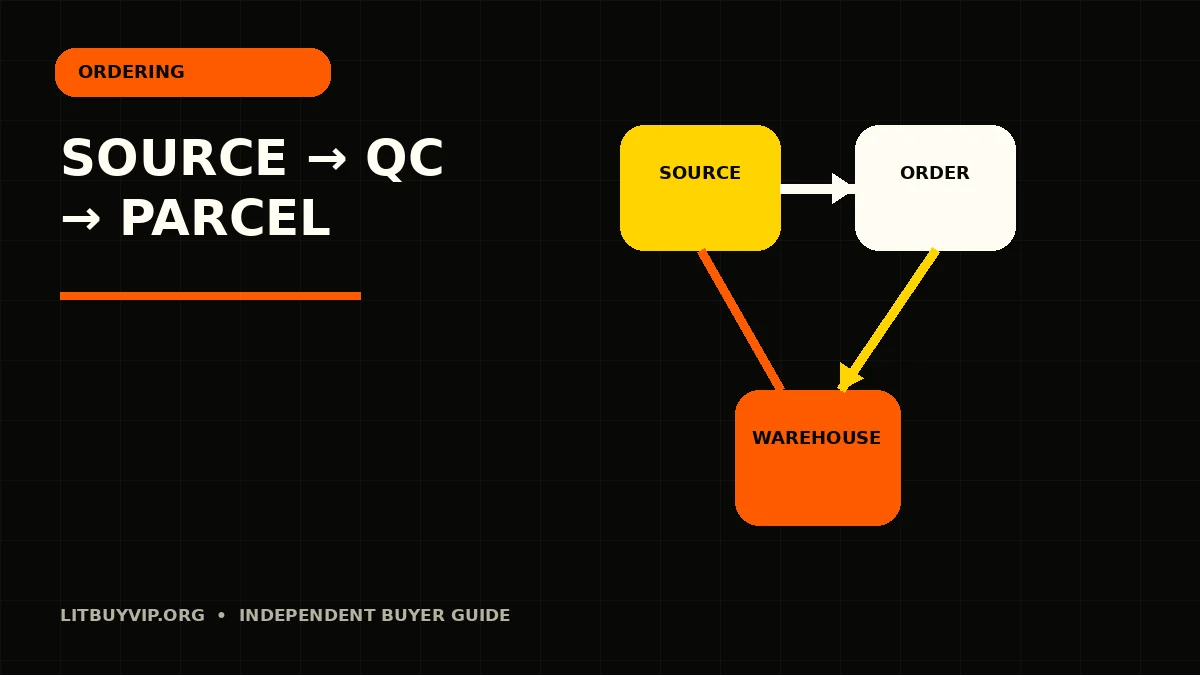
A successful LitBuy order is not created by pasting a product link and hoping the warehouse recognizes your intent. Marketplace pages can contain many colors, sizes, bundles and seller notes, while the agent must turn your selection into a domestic purchase, warehouse record and eventually an international parcel. LitBuy publicly presents purchasing services for Chinese marketplaces and also supports forwarding workflows, but those paths assign responsibility differently. This guide follows one evidence chain from source listing to dispatch. It explains what to record, when to pause and how to review the physical unit that arrives. It does not guarantee seller stock, product quality or route acceptance. Those facts must be checked at the stage where they become visible.
Choose purchasing or forwarding before you touch the cart
In a purchasing workflow, you give LitBuy a supported marketplace listing and the platform places or manages the domestic order according to the options you submit. In a forwarding workflow, you or another party buys the item and sends it to the LitBuy warehouse using the warehouse details and intake process shown in your account. The first path centralizes more of the buying record. The second gives you control of the external purchase but makes accurate tracking registration and item identity especially important. Choose the path that matches who will pay the seller and control the domestic shipment.
Write a responsibility line before ordering: who confirms the listing, who selects the variant, who pays the seller, who receives seller messages, and who supplies domestic tracking. If you cannot answer one of those questions, the order is not ready. Forwarding is not simply a cheaper version of purchasing, and purchasing does not transfer every marketplace risk to the agent. Seller stock, listing accuracy and the limitations of visible inspection remain relevant. The right path is the one whose handoffs you can document completely.
Preserve the marketplace listing as it existed when you decided
Save the source marketplace, seller identity, listing title, selected product options, quantity, displayed price and date checked. For Taobao, Weidian, 1688 or another supported source, the important evidence is not the marketplace logo; it is the exact combination you intend to buy. A single page may sell a shirt, replacement part, deposit and full set through different options. Keep a screenshot of the option state and write it in plain language. If the title or price appears inconsistent with the selected image, stop and clarify before payment.
Do not rely on a spreadsheet thumbnail or a creator's caption as the purchase specification. Discovery sources help you find candidates, but the current seller page controls stock, options and price. Follow the link to its live destination and make sure it has not changed into another product. Record essential included components and any measurement information that affects acceptance. If the page requires a conversation to establish the real configuration, preserve that conversation with the order record. Your later QC decision can only test details that were made explicit before purchase.
Translate the selected option into a one-line order brief
Create a sentence that another person can execute without reopening your browsing history: one black jacket, seller size large, removable hood included, no alternate color. Use seller size labels as written and add measurements separately. For a batch order on 1688, list each color-size-quantity combination as its own line. For footwear, record the seller's marked size and any measurement basis you used. For electronics or accessories, record model, connector, color and included pieces. A clean brief prevents the selected option from disappearing inside a long note about preferences.
Separate hard requirements from requests. A hard requirement changes the buy-or-cancel decision, such as size, model or quantity. A request may be helpful but cannot always be verified before purchase, such as selecting the best-looking unit from an unopened batch. Do not ask the purchasing agent to infer authenticity, long-term quality or fit from a listing. If you have an acceptable fallback, state it explicitly; otherwise instruct the order to pause when the selected option is unavailable. Silence should never be interpreted as permission to substitute.
Check the LitBuy order summary before payment
Compare the LitBuy order summary with your brief line by line. Confirm source link, displayed product, selected attributes, quantity, product amount and any current domestic or service charge. LitBuy publicly promotes a zero-markup purchasing model, but you should still read the live checkout for the complete amount and terms shown to your account. A marketing phrase does not replace the transaction detail. If the system asks for manual information because the listing cannot be read automatically, verify every field before funding it.
Give each order a stable local name that remains meaningful when thumbnails change. Pair it with the LitBuy order identifier and source reference. Save the payment state and timestamp after authorization. Do not treat payment as proof of seller dispatch. The next events are operationally different: purchase handling, seller acceptance, domestic dispatch, warehouse arrival and storage. Recording those stages prevents a quiet seller delay from being mistaken for a warehouse problem and helps you ask the right party the right question.
Register forwarding parcels before the warehouse has to guess
For forwarding, use the current warehouse address and intake instructions visible in your LitBuy account. Warehouse details can be specific to a user or process, so do not copy an address from an old video. Register the external order and domestic tracking as soon as the seller provides a valid number. Include a concise contents manifest with source seller, item names, quantities and your own identifiers. A parcel that arrives without a matching record forces the warehouse to solve an identity problem you could have prevented.
Track domestic shipment events, but separate seller claims from carrier scans. A message saying shipped is not the same as an accepted tracking event. If the seller uses multiple packages, register each number and map its expected contents. If several orders share one domestic package, state that consolidation clearly. Preserve the external payment and seller messages because LitBuy may not control that commercial relationship. Forwarding works best when the handoff record is complete before the carton reaches the receiving desk.
Read order status as evidence, not a countdown
Use status labels to identify the current owner of the next action. A purchase-stage status concerns payment or buying. A seller-dispatch stage concerns the marketplace seller and domestic carrier. A warehouse-receipt stage concerns matching and inspection. Do not convert a generic status into a promised date. Instead, record each visible timestamp, the latest confirmed event and the unresolved question. If a seller has not dispatched, ask about purchase or stock; if tracking shows delivery but no warehouse match, provide the number and manifest to intake support.
Price changes and out-of-stock messages require a fresh decision. Compare the new price or substitute with the original brief rather than approving from fatigue. If the selected option is unavailable, either choose an explicitly verified alternative or cancel according to the current order flow. Never let a seller replace size, color or model merely to keep the order moving. The objective is not the fastest warehouse arrival; it is a physical unit that can still be reconciled with the reason you bought it.
Review warehouse QC in the right order
LitBuy publicly advertises free inspection or QC photos for warehouse arrivals. Start with identity: product type, color, marked size, model, quantity and included pieces. Then review overall form, paired-item symmetry, construction lines and visible surface condition. Measurements come next when fit or dimensions matter. A photograph can show observable features, but it cannot establish comfort, internal performance, material composition or long-term durability. Write separate verdicts for confirmed, uncertain and mismatched facts.
Request an additional photo only when it can change your decision. State the exact area, orientation and reference needed, such as a close view of the sewn size label or a tape measurement between two visible endpoints. Do not ask for a vague better picture. If the item differs from the brief, keep it outside any parcel and open the current after-sales path promptly. Attach the order record and decisive warehouse frame together so the reviewer sees both the promise and the received unit.
Close returns and exchanges before parcel planning
An unresolved item should never enter the shipping plan. If clarification, exchange or return is needed, mark the unit as quarantined and preserve the visible option in the current LitBuy interface. Seller rules and timing can differ, so do not apply a universal return deadline from another marketplace. Act promptly, record each request and verify the outcome in the order record. An exchange is not complete when the seller agrees; the replacement must reach the warehouse and pass a new identity and condition check.
Reconcile any refund with the exact order and account movement. A value returned to LitBuy balance is different from a withdrawal to the original payment method. If the case changes the haul, update the product ledger and remove the old unit from the parcel manifest. Closing the exception first protects the rest of the order. It also prevents shipping payment from creating a harder problem: an unwanted product crossing the international boundary while the buyer is still discussing a domestic seller remedy.
Build the parcel from settled warehouse units
Once every selected unit has an accept, return or hold verdict, create the parcel candidate. Check route eligibility for each item and destination, because batteries, liquids, magnets, branded goods and other attributes may narrow the available lines. Review packaging choices, actual and estimated volumetric weight, address and declaration details. LitBuy presents global shipping and packing services, but the live parcel screen defines the routes and quotes currently available for your combination. Save the final contents and choices before payment.
The complete evidence chain should now be visible: source listing, order brief, LitBuy order, domestic tracking, warehouse identity, QC decision and parcel manifest. Keep those layers distinct, because each resolves a different dispute. Ordering through an agent does not eliminate marketplace uncertainty; it creates checkpoints where uncertainty can be reduced before international shipping. A careful buyer uses those checkpoints in sequence and never asks the last stage to repair a choice that should have been documented at the first.
Use the same checklist for the next purchase
Archive the final result beside the original brief. Note which listing detail was hardest to interpret, which warehouse view decided acceptance and whether the packaging or route changed the total. Use that evidence to improve the next order note. If a size measurement prevented a mismatch, make it a required field for that category. If a seller substituted an option, require a pause instruction next time. The value of an order record is not only resolving one case; it is turning the next purchase into a more predictable process.
The short version is: choose the workflow, freeze the listing, write the variant, verify the checkout, track the domestic handoff, inspect the warehouse unit and ship only settled goods. Taobao, Weidian and 1688 have different page structures, but the evidence problem is the same. Your intent must survive every handoff. When it does, LitBuy can operate on a clear instruction and you can judge the received item against a record rather than a memory.