
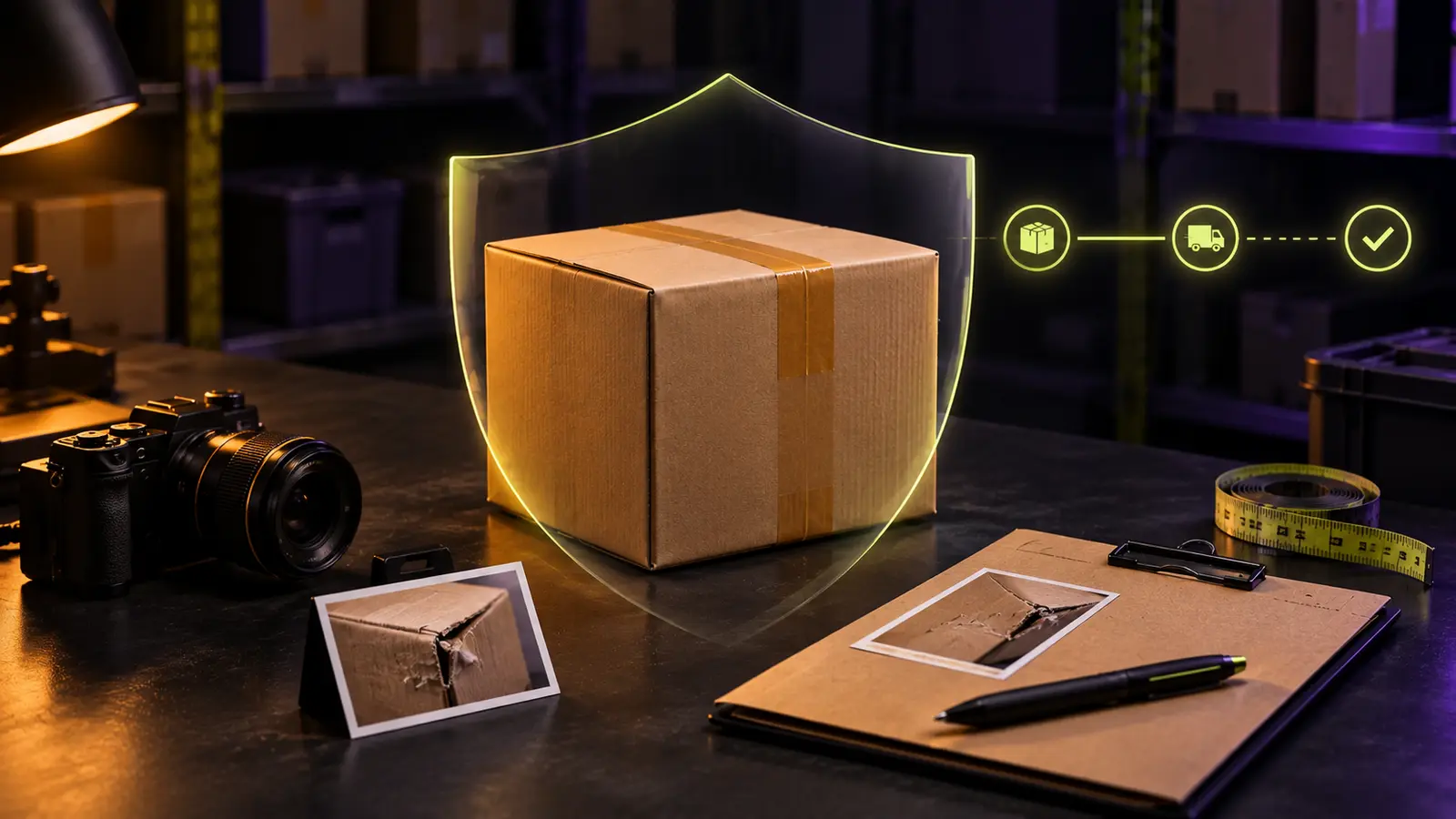
Parcel protection is easy to misunderstand when it is treated as a promise instead of a process. LitBuy's current public guidance separates international shipping problems into delay, damage and loss. It says delayed parcels are not currently compensated, while damage or loss may be handled under the platform's compensation standards after verification. That distinction should change what a careful buyer records before shipment. A screenshot created after something goes wrong cannot reconstruct the carton, the contents approved at the warehouse or the value attached to each item. The practical job is to create a clean shipment baseline, understand the claim clock and give the recipient a simple evidence routine. This guide does not predict whether a claim will be accepted or what any case will receive. It shows how to preserve facts that let LitBuy support evaluate a request without relying on memory or unrelated screenshots.
Start with the current rule, not shipping folklore
Open the current insurance and compensation guidance before submitting the parcel and write down what it actually says on that date. Do not substitute an old social post, a friend's result or a carrier policy from another route. The published LitBuy page currently identifies delay, damage and loss as different abnormal situations. It also states that delay does not receive compensation at this time. A late scan may deserve an inquiry, but it should not be described as an insured loss merely because the expected range has passed.
Create a policy snapshot with five fields: route, parcel submission date, warehouse shipment date, protection shown for the selected route, and the guidance reviewed. Record only information visible in the current account or public policy. If a fee, insured amount or coverage label is not shown for your parcel, leave it unconfirmed. This prevents a general phrase from becoming a private guarantee. The first decision is whether you can state exactly which current rule you are relying on.
Separate delay, damage and loss before collecting evidence
Use three columns from the start. Delay means the parcel has not arrived within the expected movement pattern but has not been established as lost. Damage means the parcel or contents arrived with a physical problem. Loss means the shipment or part of its contents cannot be accounted for after the relevant investigation. These labels are not interchangeable. A stopped tracking event is evidence of a stop, not proof of loss, and a crushed outer corner is evidence of impact, not automatic proof that every item inside is damaged.
For each category, write the question that remains open. A delayed parcel needs a dated movement timeline and an inquiry about the last confirmed handoff. A damaged parcel needs a before-and-after condition comparison. A possible loss needs proof of dispatch, tracking history and a clear inventory of what is missing. Keeping the categories separate makes the support request easier to read and stops the buyer from asking for three incompatible remedies in one message. It also preserves credibility when the facts change during the investigation.
Treat the claim clock as an operational deadline
LitBuy's current guidance says the compensation timing period begins when the parcel ships from the warehouse. It also lists a claim as ineligible when no inquiry or compensation request is made within seven days after delivery or within forty-five days after shipment. Record the warehouse shipment timestamp as its own event; do not replace it with the marketplace order date, warehouse arrival date or parcel payment date. They answer different questions and can be weeks apart.
Build reminders around evidence, not panic. When tracking begins, save the parcel number, logistics number and first carrier event. At delivery, record the visible timestamp and tell the recipient that the post-delivery window has started. If the parcel remains unresolved, do not wait until the outer limit to inquire. The published windows are reasons to act early, not estimates of investigation speed. Verify the live guidance again when an exception occurs and preserve the version you relied on.
Prove what the parcel contained before it leaves
Create a shipment manifest from the warehouse items selected for the parcel. Give every line a recognizable item name, quantity, selected variant, warehouse order identifier and visible condition decision. Similar black shirts or repeated accessories need separate identifiers even when they came from the same seller. The purpose is to answer a later question precisely: which physical unit was supposed to be inside this carton? A shopping cart screenshot is not enough when it contains cancelled items, goods left in storage or several versions of the same product.
Attach the final warehouse evidence that matters to each line. Use overall photographs for identity, close views for a known condition, and measurements only where they were actually supplied. Do not describe basic exterior QC as proof of internal performance or long-term durability. If an item already showed an accepted flaw, record it before shipping so it is not presented later as transport damage. A useful baseline distinguishes pre-existing condition, packaging risk and new damage instead of forcing support to infer all three from delivery photos.
Record value without inventing a replacement price
For every manifest line, preserve the amount actually paid and the order record that connects that amount to the item. Keep product payment, domestic delivery, optional service charges and international freight in separate fields. They may be treated differently under current terms, and combining them into one unsupported loss figure makes the request harder to audit. If the seller changed the price or issued a partial refund before shipment, use the final paid record rather than the earliest listing screenshot.
Do not increase a claim because the product is now unavailable, costs more elsewhere or feels more valuable after delivery. Likewise, do not assume that every recorded cost is compensable. The official page says verified compensation is refunded to the LitBuy account balance, but it does not turn your spreadsheet into an approval. Your ledger should show the source of each number and leave the compensable amount for the platform's review. Precision is more useful than an ambitious total that cannot be reconciled with account records.
Freeze the parcel baseline at submission
At parcel submission, save one compact record containing the selected items, route, destination country, declared contents, requested packaging, quoted shipment details and any protection displayed for that exact choice. After packing, add the final measured weight, dimensions and logistics number when they become available. Keep the pre-pack estimate and final parcel data as separate versions. Replacing the estimate hides useful evidence about what changed between planning and dispatch.
Packaging instructions need the same discipline. Record whether original packaging was kept or removed and whether reinforcement or another protective option was requested. Do not claim that a packaging choice guarantees survival; use it to establish the plan that existed before handoff. If a fragile or shape-sensitive item travelled with minimal protection because you accepted a compact scenario, that fact still belongs in the record. A claim file is strongest when it documents decisions honestly rather than editing the history to make every choice look cautious.
Give the recipient a five-minute delivery routine
The recipient often controls the most time-sensitive evidence, so send the instructions before delivery. Ask them to photograph every side of the unopened carton, the label area, seals and any crushed, wet, torn or retaped section. If visible damage is present, they should capture it in context before moving loose material or cutting tape. The photographs should establish the whole parcel first, then the detail. A close-up of a tear without a wider view cannot show where it occurred on the carton.
Next, open the parcel in a continuous sequence when practical. Show the seal, the first view of internal packing, each item as removed and the empty carton. Keep the carton, cushioning, damaged goods and labels while the case is unresolved. The current policy excludes damage or loss caused by customer negligence and theft or loss after delivery beyond LitBuy's control, so distinguish arrival condition from anything that happened after handoff. Public posts should redact names, addresses and tracking numbers.
Describe damage as a change, not an emotion
Build the damage statement around four facts: the item, the location, the visible change and the effect. For example, identify a rigid case, its lower-left corner, a new fracture and the fact that the closure no longer aligns. Avoid broad phrases such as everything is ruined when only one component is shown. Pair the delivery evidence with the closest warehouse baseline and mark what was already visible before shipping. This lets a reviewer see the change without searching across dozens of files.
Separate outer-carton damage, internal packaging failure and product damage. They may support one another, but they are not the same observation. Count missing pieces against the frozen manifest instead of estimating from memory. If the issue could be an inherent product defect rather than shipping damage, say so and ask how it should be classified. LitBuy's current exclusions mention problems inherent to the product itself. A precise uncertainty is safer than confidently assigning the wrong cause.
Investigate possible loss without declaring it early
For a parcel that has not arrived, preserve the full tracking sequence exactly as displayed, including carrier names, location wording and timestamps. Mark confirmed events, estimates and interpretations differently. Contact support with the parcel identifier, logistics number, last confirmed event and the specific question you need answered. Do not convert a long gap into a fabricated loss date. The status should remain unresolved until the appropriate party confirms what can be established from the route records.
For missing contents, compare three inventories: the warehouse items assigned to the parcel, any packed-parcel detail available in the account and the recipient's continuous unpacking record. State the exact missing line and quantity. Check whether the order remained in storage, moved into another parcel or was split before alleging in-transit loss. This reconciliation is especially important for repeated products. The claim should begin where the records stop agreeing, because that point tells support which handoff requires investigation.
Run the exclusions test and submit one auditable case
Before submitting, review the current exclusions. LitBuy lists missing evidence, missed timing, post-delivery theft outside its control, non-insurable categories, prohibited or restricted items, lawful confiscation or disposal, customer negligence, inherent product issues and force-majeure events among situations where compensation is unavailable. Do not hide an uncomfortable fact. Label it and ask how the rule applies. An accurate ineligible case is better than building a claim around a condition the published guidance excludes.
Send one concise narrative: what shipped, when it shipped, what happened, which item or parcel is affected, what evidence is attached and what decision you are requesting. Number attachments to match the timeline and manifest. Save the submission time, case identifier, requested follow-up and every response without overwriting earlier entries. The official guidance says approved compensation is returned to the LitBuy account balance after verification, so close the ledger only when the decision and balance entry can be reconciled. Good preparation cannot guarantee compensation. It can make the facts complete, timely and difficult to misunderstand.