
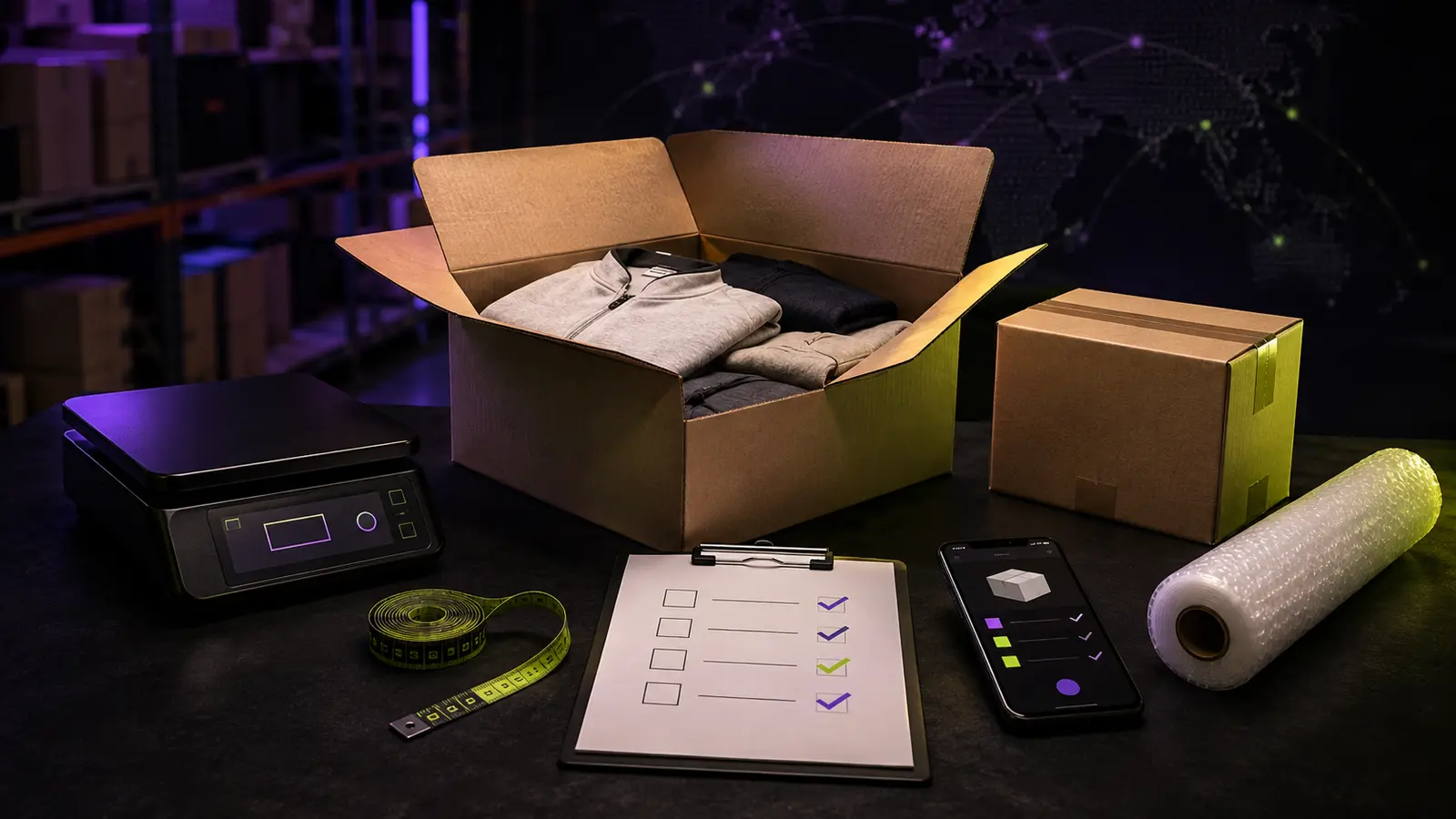
The most expensive parcel mistake is often made after every item has already reached the warehouse. At that point, a rushed buyer sees a complete haul and clicks submit. A careful buyer sees a short inspection window: the last practical moment to reconcile the order record, isolate unresolved defects, test packaging choices, confirm transport compatibility and preserve evidence. This preflight turns that moment into a repeatable audit rather than a hopeful final click.
Freeze the manifest before touching the parcel controls
Begin by closing the shopping phase. Create a frozen manifest containing only the items intended for this shipment: warehouse identifier, marketplace title, selected color and size, quantity, recorded weight, arrival date and current QC verdict. Do not add another inexpensive item while auditing. A moving target makes it impossible to know whether the route, carton and budget you review at the beginning still describe the parcel you submit at the end. If a late product genuinely matters, return it to a separate candidate list and rerun the preflight from the top.
Give every row one of four destinations: ship now, hold for evidence, move to another parcel or remove from the plan. The wording matters. Approved is too vague when an item is physically in the warehouse but incompatible with the intended route. Ship now means its identity, visible condition, transport attributes and parcel role are all settled. Hold means one answer could change the verdict. Move means the item is acceptable but belongs with a different compatibility group. Remove means it no longer earns international freight.
Reconcile what arrived with what was actually ordered
LitBuy publicly describes purchasing support for products from marketplaces such as 1688 and Taobao, along with DIY ordering and forwarding to its warehouse. Those workflows can produce different source records, so the warehouse title alone is not a reliable specification. Open the saved order details and compare the exact variant against the warehouse entry. Check color, labeled size, model, quantity and included pieces in that order. A generic warehouse label can be correct while the selected option is wrong; a familiar product photo can hide a missing strap, insert or accessory.
Build a one-line identity sentence for each item: what it is, which variant was purchased and what must be included. Then test the warehouse evidence against that sentence. This is faster than browsing every photograph without a question. If the sentence says a charcoal zip jacket, size medium, with detachable hood, the audit has four observable facts. If any fact is absent from the current views, do not convert uncertainty into approval. Place the item in the evidence queue and identify the single view or measurement that would resolve it.
Clear the QC exception queue with stopping rules
LitBuy currently advertises free QC and inspection photos after goods arrive. Use those photographs as an exception system, not a gallery. Start with the items marked hold and write the concern in neutral language: left heel appears taller, chest measurement is not visible, zipper pull is missing, or color differs across frames. Avoid conclusions such as defective until the evidence supports them. Lighting, folds and camera angle can create apparent problems, while a wrong size tag or missing component is a direct mismatch that should not be explained away.
For each concern, choose a stopping rule before seeking more evidence. Pass if a level rear view shows equal heel height. Reject if a flat measurement falls outside the prewritten range. Move if the product is fine but its structure requires a safer parcel. A request for more pictures without a stopping rule usually produces more images and the same uncertainty. LitBuy also presents after-sales support for missing or damaged items in its Help Center, so preserve the order record and relevant photographs when an issue may require formal handling under the current rules.
Map transport attributes before combining boxes
LitBuy states that warehouse items can be combined and shipped together, but physical consolidation does not make every mix transport-compatible. Add an attribute field beside each manifest row. Standard fabric is one group. Batteries, liquids, magnets, powders, fragile objects, sharp parts, oversized pieces and pressure-sensitive containers deserve separate review. The platform publishes prohibited-item guidance and exposes a freight estimator, which means eligibility should be checked against the current destination and route choices rather than inferred from an old haul or a social post.
Run the compatibility test in both directions. First ask whether the special item can travel at all under the current rules. Then ask what happens to the standard items when it joins them. One small attribute-sensitive product can narrow the lines offered to an otherwise simple clothing parcel. If the combined group loses an appropriate route, model the special item alone, postpone it for a compatible shipment or remove it. The purpose is not to fear unusual products; it is to stop one hidden attribute from silently redesigning the whole parcel.
Assign packaging by failure mode, not by habit
LitBuy advertises packing and reinforcement based on item size, but the buyer still needs to define the risk worth controlling. For each product, name the most plausible shipping failure. A structured bag may collapse, a shoe may crease, metal hardware may scratch a neighboring surface, a liquid container may leak, and knitwear may simply occupy excess air. Packaging becomes rational when every layer answers one of those failures. Decorative retail packaging that controls no meaningful risk is a volume candidate; a rigid insert protecting a shaped item may be essential.
Create three instructions: keep, remove and protect. Keep lists the boxes, supports or sleeves that preserve shape or value. Remove lists hangers, decorative paper and empty retail volume that can disappear safely. Protect lists actions such as separating hardware, waterproof wrapping, edge support or cushioning movement. Do not issue contradictory commands such as remove all packaging and reinforce heavily. If reducing volume exposes the item to the very damage reinforcement must prevent, choose the balanced treatment and accept the honest parcel size.
Forecast the packed carton, then challenge the forecast
The warehouse weights describe separate items, not necessarily the final packed carton. Add an allowance for the outer carton and protective materials, then sketch a plausible arrangement by shape. Foldable clothing can occupy voids; shoe boxes and structured bags establish hard dimensions; long objects may determine one carton edge even when they are light. Use the LitBuy freight estimator as a current scenario tool after choosing a destination and reasonable packed measurements. Do not treat an early estimate as a guaranteed invoice, because measured dimensions, route rules and product attributes still control the submitted result.
Challenge the first estimate with two alternatives. In the compact version, remove only packaging already classified as safe to remove. In the protective version, preserve structure and add justified clearance. Compare not only price but available routes and the higher of likely mass or dimensional charging logic shown for the chosen line. If a small dimensional reduction changes nothing important, keep the safer treatment. If one rigid box moves the parcel into a different charging or eligibility outcome, its true cost becomes visible before payment.
Use storage as a clock, not as invisible capacity
LitBuy currently promotes storage of up to 120 days with the first 90 days free, while its Help Center summarizes 90 days of free storage and fees after an overdue period. Because operational terms can change, confirm the live account deadline for every item before relying on a public summary. Sort the manifest by warehouse arrival, not purchase date. The oldest item sets the urgency, and a late seller should not disguise the fact that another product is approaching a storage decision.
Set two dates: an evidence deadline and a submission deadline. The evidence deadline is the last day for resolving measurements, condition questions or return options without compressing the parcel decision. The submission deadline leaves time to compare current routes and packaging calmly. This turns storage into planning runway. Without dates, buyers often use the free period as permission to postpone, then accept weak evidence or poor grouping because several unrelated clocks have suddenly become urgent.
Compare routes as operating choices
Once the manifest and packaging scenario are stable, compare the routes currently presented for the destination. Eligibility comes first. After that, record estimated charge, stated delivery range, tracking visibility, size or weight limits, handling fit and the current protection or compensation terms. A cheaper line is not comparable if it excludes an attribute or handles the carton shape poorly. An expensive line is not automatically safer if the available terms do not address the parcel's actual risk.
Separate seller handling, warehouse waiting and international transit in your schedule. A displayed delivery range normally concerns only part of the journey and should not be converted into an event guarantee. If the contents are needed by a date, calculate backward with a buffer and be willing to split a slow or unresolved item from the ready group. The right route is the one whose assumptions match the frozen manifest, not the one that won a generic ranking before the parcel existed.
Build an evidence pack before payment
LitBuy describes real-time tracking across storage, inspection and shipping progress, and its Help Center directs users to after-sales handling for non-delivery, missing or damaged items. A useful evidence pack connects those stages. Save the frozen manifest, order identifiers, selected variants, decisive QC images, accepted measurements, packaging instructions, warehouse weights, chosen route details and the final quoted amount. Keep the records together rather than relying on a stream of screenshots with no labels.
Write a short parcel note listing anything unusual: retail box intentionally removed, detachable part packed separately, fragile hardware protected, or two identical items included. After submission, save the parcel identifier and tracking record beside the same manifest. At delivery, photograph exterior damage before opening and document contents in a continuous, orderly way when the current claim requirements make that useful. Evidence is not pessimism. It is the bridge between what the warehouse showed, what the parcel promised and what arrived.
Run the final sixty-second gate
Immediately before submission, ask ten binary questions. Is every manifest row present once? Does each item match the selected variant? Are all QC holds closed? Are transport attributes declared and route-compatible? Are keep, remove and protect instructions unambiguous? Is the carton scenario plausible? Is the oldest storage deadline safe? Does the selected line accept the complete parcel? Are destination details correct? Has the evidence pack been saved? A single no stops the click and names the next action.
The preflight is complete when the parcel can be explained without reopening ten tabs. You should be able to say what is inside, why each item passed, which packaging risks were controlled, why the group is compatible, what the current route is expected to do and what evidence exists if reality differs. That is the practical advantage of an audit: not perfect certainty, but a shipment built from visible assumptions and closed decisions instead of momentum.